Monday, June 25, 2012
Tuesday, June 5, 2012
June 5, 2012
I always knew that Kath and I are different.
Here we were Sunday driving back from “Just Kiddin’ Around”
farm north of Allentown with four young kid goats we had just bought – three in
a homemade carrier made out of scrap plywood, hardware cloth, and two by fours,
strapped to the bed of our pickup, and one goat, the smallest, inside the truck
tucked up and sleeping on Kath’s lap…
I know it’s not what most people did Sunday afternoon. Most
cars on the roads were filled with beach balls, beach chairs, etc either coming back from
the shore or going to the shore. But like Kath said, its not so much that we are
different, its just that this is who we are…its that we love the farm life,
albeit ours is a very small farm, and we are meant to have a truck full of
goats rather than one overflowing with beach chairs.
I have resigned to the fact that I would miss the animals
and CSA more than I’d miss other things. It’s why that after we get home from
our full time day jobs we head out back to weed, plant, harvest, clean stalls,
water and feed the chickens, horses, and goats, etc. Usually we don’t get in
till it begins getting dark, then we eat dinner…and in the morning we put on
muck boots to go out and clean and feed and check on everybody before going to
work. Many times I find myself sharing a fence rail with Patrick looking up at
the stars, well before the world awakes…I don’t think that we would have it any
other way.
The following are pics of our new purebred Boer doe goats. I
am planning to raise them for eating brush and vegetation for hire – more or
less a natural way to clean up overgrown areas. Our new venture is called
“Quaker G’Oats”…Even if this venture doesn't pan out, I will still have four new friends! Its a win-win no matter!All four goats are a little over 3 months old now. Lucy is about
half the size of Irene, Frances, and Mary because her
mother ran dry early. We’ll catch her up on grain and she’ll grow out fine.
![]() | |||||
| Lucy |
![]() |
| Irene |
![]() | |
| Frances |
![]() |
| Mary |
Sunday, May 6, 2012
Honey bee swarms…
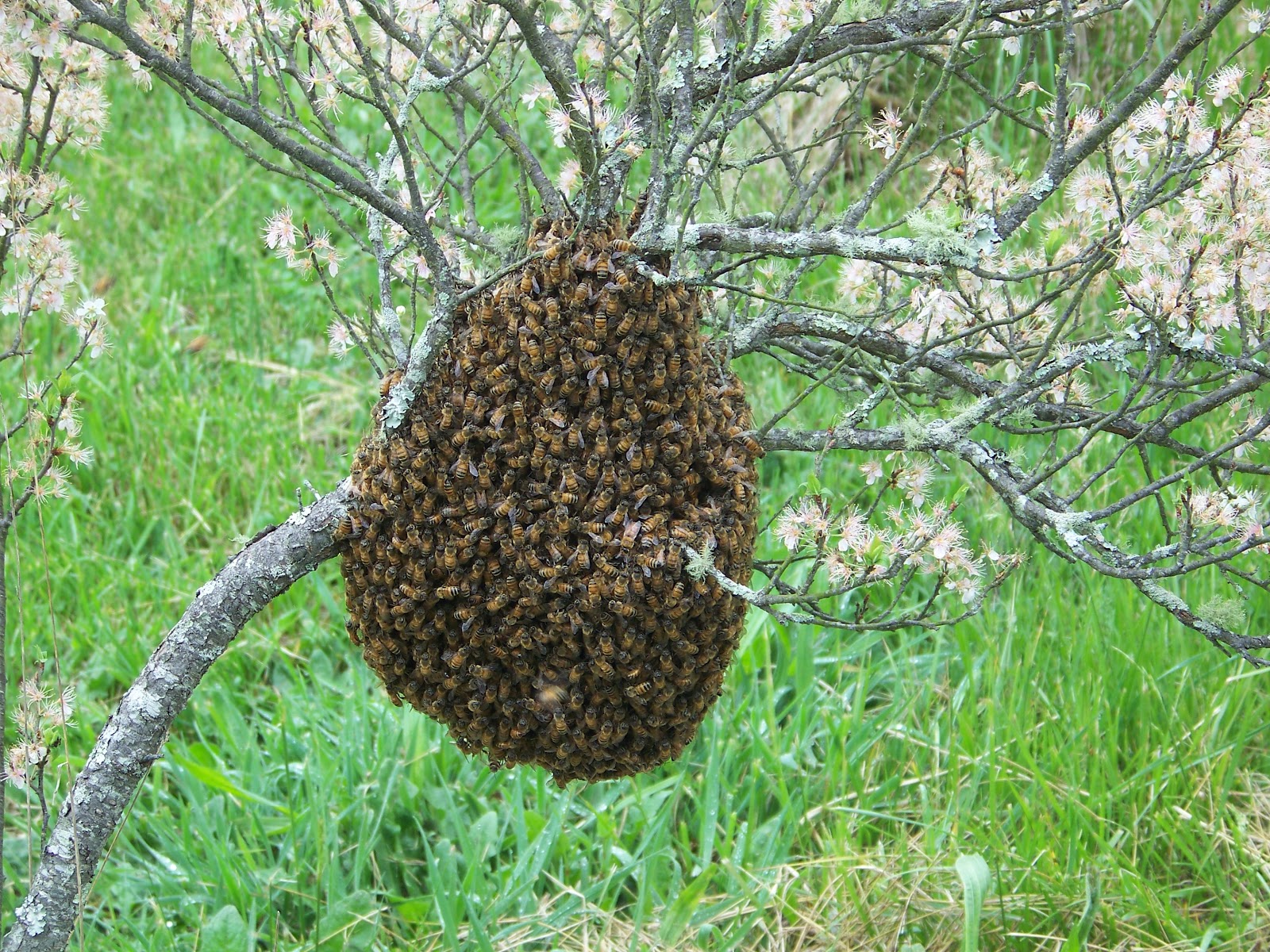
Late spring is swarm season. A swarm occurs when a hive gets
too crowded. A new queen is raised and a swarm of bees, along with the older
queen, leave the hive to find a new home. When the swarm leaves, it gathers
somewhere, usually on a tree branch. Scout bees leave the swarm to search out a
new home, and when one is found, they lead the swarm to it.
A swarm is both good and / or bad depending on how the
beekeeper looks at it. If the beekeeper can catch the swarm and re hive it,
it’s a free colony! On the other hand, the amount of bees in the original
colony is reduced, so honey production goes down. For me, it doesn’t matter. It’s
a wash.
The first swarm I saw was two weeks ago. It gathered about
15’ up in the maple tree and since it was pretty much impossible to get to, I
let it go. The next day it was gone – the scouts found it a good home
somewhere.
The 2nd a 4th swarms were easy. They
occurred about ten days apart, and both gathered on the beach plum bush in the
front yard. This bush has been a popular gathering place for years for unknown
reasons, and I have caught about 5 swarms from it. #2 and #4 swarms gathered on
the branches two feet off the ground so all I needed to do was put a hive box,
or super, under the swarm, then shake the bees off the branch so that they fell
into the super. For the most part, it was that simple.
Very easily I went from having four hives to six with a few
shakes of a branch.
![]() |
| Swarm #4 in the Beach Plum |
#3 swarm was a whole different story.
A week ago #3 swarm formed about 20 feet high up in the
young elm tree that we had planted four years ago in the front pasture. Last
year I re hived a swarm from the beach plum bush and set the hive more or less
underneath it. I am pretty sure swarm #3 came from this hive.
Up there 20 feet, I decided, like I did for the one that had
formed in the maple tree earlier in the spring, that it was too high for me to
reach and I’d just have to let it go. That was Saturday. Sunday it was still
there. When I got home from work on Monday it was still there. Same thing on Tuesday.
Of all the swarms I have ever let pass, most left in a day – I had never seen
one stay for this long without finding a new home. When I came home from work
on Wednesday…
… it was still there, but not doing too well. For five days
now the swarm was getting smaller as bees that were weak from the weather and
lack of food were dropping off. Five days without food is a long time for a
bee, and also having been exposed to three rainstorms and cold temperatures
during these five days decreased this swarm’s chance of survival. I looked up
and could hear bees dropping down through the leaves, too weak to hang on. The
swarm was also beginning to split into separate clusters, and beneath the main
swarm, a number of bees that had fallen from it clung together on a branch
below. On leaves beneath that lower branch, there were a few more small
clusters.
I figured that at this point, I would have to try to re hive
it. Better to try than to let it starve.
I put together a plan – Allen could raise me up in the
loader bucket as high as it could reach and then with my pole saw, I could
reach higher and with it, hook the branch and pull or bend it close enough for
me to reach. With the super on the bucket with me, I would then clip the branch
and then shake the bees into it.
The plan worked great for the lower cluster.
The main warm was too high for me to balance every thing and
stay steady enough to grab it. Kath stayed on the ground and used the pole to
hook the branch, but at her angle it pulled it too far from me to reach. So
Allen jumped on top the hood of the tractor and took over the pole duty. He
reached it up over my head about 5 feet, hooked the leader and slowly pulled
the swarm to me. I stretched out as far as I could and reached as far as I
could, and grabbed the branch holding the swarm. I clipped the branch from the
leader and …the leader, under so much tension, released, slipping off the pole
saw, and whipped back
I didn’t really know what had happened. I remember that I
was holding a small cluster of bees in my hand as another cloud of bees
descended on me, then on Allen, and down to Kath who was standing in the
pasture watching. I started taking stings, but holding the little cluster and
up in this bucket I didn’t have much choice but to submit to the assault and hope that it would be just a few bees. It
wasn’t.
Kath took off, wiping bees off her as she ran off down the
pasture. I was getting pummeled, and so was Allen. I somehow managed to get the
small cluster that I was holding into the super, and jumped down out of the
bucket onto the hood with Allen, who was still holding the pole. I almost
knocked him off. We both jumped down and hurried away, with angry bees stabbing
our skin and more in tow.
We all were stung up. When it was over, Kath had gotten
quite a few stings, Allen more, and I even more than them. I couldn’t even
estimate how many times I had been stung – my arms, neck, face, ears, and head
were burning and I couldn’t separate the pain into each sting – I just burned
all over. In pain, a bit exhausted from
the stings, we all just stood at the bottom of the pasture “licking our
wounds”. This had never happened before.
Kath saw what had happened: the cluster was actually
gathered around two branches – one we couldn’t see from where we were. When I
cut the one branch, I was left with a cluster, but the other half, still
clinging to the hidden branch, went flinging through the air when the leader
released, and that got them very riled up.
So there we were. Out in the field the tractor was running,
a super in the raised bucket, and a small cluster of bees now higher in the
tree, but too riled up to go near. And the three of us so stung up it was hard
to move or to think bout anything else but the pain.
But I couldn’t leave it at that.
A half hour later the bees had settled down and since I
wasn’t sure if I had gotten the queen in the previous clusters, I decided to go
back and finish off the job. Allen and Kath reluctantly helped. We set up
again, and this time Kath on the ground got a better angle to pull the leader
to me. I clipped the branch, dropped the cluster in the hive, and that was it.
All calm. As easy as buttering bread.
I put the super in the yard and fed it sugar water, then
went in for the night. A very uncomfortable night as the burning wasn’t going
down.
To make a long story short, I ended up in the doctors office
the next day as for the first time ever, rashes began rolling across my body
and I felt very warm. I had never had a reaction to stings before, nor even
multiple stings. Turns out it wasn’t really serious – but simply my body
reacting to a bit more than it could handle. The doctor, who was fascinated by
the story as he wants to keep bees sometime in the future, put me on a few meds
to calm my body down. (Luckily, Kath and Allen didn’t get the reaction from the
stings that I got)
When I got home from the doctors, I checked on the hive. The
bees had left.
There they were, back in the elm tree. All that for nothing!
And now it is Sunday, eight days later and the bees are
still there. Maybe a quarter of them are left, weak, but with enough sugar
water to sustain them for a few more days. I hope.
![]() |
| Remnants of swarm #3 in the elm tree. |
I have decided that it is what it is. I won’t try to re hive
this swarm again. I have done all that I
can, and have taken all I can from this swarm. Nature will need to care for this
swarm now. It won’t let me. Good luck swarm #3. I wish you had chosen to gather
on the beach plum bush….
Thursday, April 26, 2012
April 26, 2012
The other day I took my camera with me to Still A Hill when
I went there to see Zipps. I have been going over there at least once or twice
a week to see him. I halter him and take him out on a lead for grass. We just
browse around the lane and the area around the stables for about an hour or so
– he gets out, gets a bit of grass and I get to relax – I am not at work, not
at the farm – Me and Zip have an hour without any expectations put upon us. We
all need that every once in a while.
Back to my camera….so I took a few shots while there. It
wasn’t easy to stay steady with a camera in one hand and a horse on the other,
but I tried. I would have liked to have taken more too, and I will try to the
next time I go.
For now, these are some pics I took that day-
Saturday, April 7, 2012
April 7, 2012
Last night as the clerk of my Quaker Meeting, I took part in the areas ecumenical Good Friday service. This is what I said:
What I want to share is a
leading…a leading, in Quaker speak, is when God speaks through you. Its
something that you cant shake off, ignore, or just forget about. It comes to
you, into you. It stays with you, everywhere you go…..a leading is god
speaking. A leading is Gods message.
Its God telling you what to do…God has given them to you…. This is a leading
that God gave to me.
My leading is a poem. Ever
since Pastor Tom sent me an email and asked if I’d like to say something at
Good Friday, this poem has surfaced in me and wont leave. Fact is, this poem is
always with me, but when it usually comes to mind once or twice a day, now it won’t
sit down. It just repeats to me all through the day, each day. It is God
speaking. God wants me to share it. I don’t know why. But I know God wants me
to, so I trust …
The poem was written some
some 600 years ago, by the Sufi mystic poet, Hafiz…
This is the poem –
“So Thirsty”
First the fish has to say
Something ain’t right about this camel raise
And I am so thirsty
This poem can be interpreted
in many different ways – which is why it’s remembered all these years – it
survives change. It can be interpreted as just a simple lyric that is just for
fun – a fish on a camel – of course
he’s thirsty! Or about becoming lost…the fish is definitely lost. Or maybe all
this silliness isn’t silliness at all
To me the poem is about
searching for God, about leaving what we know to search for what’s missing –
it’s our thirst for finding God.
Its can go deeper than that
too. The fish would not be thirsty had he not left the water he once lived
in…something isn’t right, we need God to survive
It is also about faith….
Faith.
It takes faith to say
something isn’t right…it takes faith to admit you are so thirsty. It takes
faith to seek God.
Jesus had faith.
Jesus was always moving
towards God…. by faith. That was what Jesus’ life was about.
And maybe that’s what God is
trying to tell me…to keep moving towards God. To keep my faith. To let my faith
carry me back to the water where I belong.
Didn’t Jesus say?
“Seek and you shall find”
First the fish has to say….
And that is my leading…it
speaks to thy condition. It speaks to thy condition every day. …thanks for
allowing me to share my leading with you on this Good Friday…Amen.
Tuesday, March 27, 2012
March 27
Last Friday Tanya, our vet, came out to give the horses
their spring shots – rabies, west Nile virus,
etc. Zippy received a few extra shots for diseases that I can’t begin to
pronounce. On Saturday Zips will be going to the barn where Kath takes riding
lessons and he will stay there for the month of April to get exercised and
retrained for some serious riding. Zip is a former dressage champion, retired.
And he’s had it good here, eating grass. Pretty much the only stress he has here
is Patrick coming up behind him to nip him on his butt.
We bought the trailer so that Kath could take Patrick to the
barn for lessons, but that didn’t work out too well. Patrick didn’t mind, but
he isn’t very athletic and has some kind of gait that the trainers didn’t want to
work with. They pretty much said he’s a great trail horse, but his body was
never meant for ballet. One of those “I like you, but lets just be friends…” deal. So they asked what else
we had….
Lou only walks, unless he smells a peppermint, or if Patrick
nips him in the butt – then he will run. But we pretty much figured that the
trainers weren’t going to offer him peppermints and I couldn’t quite picture
Sophia or Illona sneaking up behind him and biting him in the butt to get him
to move…trainers aren’t born with too much of a sense of humor. Lou wasn’t
gonna work, so it was no use to even contemplate it.
So that left Zips. And so poor ol Zips got marched into that
new trailer that was meant for Patrick and sped off to the barn for a
trial. ‘Ol Zips did all the right moves
and had the right gait or whatever…things that trainers know about but
something I may never understand. Dumb ‘ol Zips – had he been smart enough and
trotted out of whack and not responded to Sophie’s heel, he’d been home free
and left to enjoy grass and retirement and hang out with me in the back field. Just
like Patrick and Lou. But no, not Zip! he decided
to show off. The dummy.
So this Saturday he will be loaded into the trailer for an
extended stay. He will get good care. During the week he will get exercised and
put in shape. He will get re trained to get his responses sharpened up. Kath
will go over every Saturday to take lessons on him. He’ll be fine.
But I will miss him. Sorta like sending your kids off to
college – ya know it’s a good thing, and the right thing, but it still leaves
that bit of emptiness that never gets totally refilled….
The problem with me and animals is that I get way too
attached. Way too attached.
Monday, March 12, 2012
March 12, 2012
Spring’s here! The light is lasting longer as the earth’s
wobble tilts us closer to the sun.
Today the bees were bringing in pollen – grey, yellow,
white, and red – from crocus, daffodils, etc, and from trees, especially the
swamp maples that are bursting with petite red flowers. Some bees were fat with
nectar as they landed; a sure sign that honey is starting to be made, and brood
is being fed.
The chickens are laying more eggs each day now. The 25
chickens average about 18-20 eggs every week in the winter and as the days get
longer, laying increases each week. Chickens are scheduled by the sun. Last
week we were up to about 50 eggs, and today alone we collected 11. (I guess for
25 chickens it could be more, but not all of them lay eggs anymore because they
are up there in years. I let my chickens live out their life here…I figure that
they’ve provided for me and it’s only right for me to provide for them in
return.) By early summer, we might top out at about 70 eggs a week, and then a
little less as the heat slows the girls down a bit.
It’s also the shedding season. Now, when we groom any of the
hippos, the brush gets so full of hair in just a few strokes that it needs to
be cleaned out. Same is true when I brush Snoops. Small birds swoop down now
and then to pick up what hair lands on the ground and use it for making their
nests. Nature doesn’t let much go to waste. It’s almost as if it’s all planned
out and everything timed to fit together…
The wild turkeys are putting on shows each day – in the back
yard and front pasture, males are strutting with their feathers all puffed out.
Wooing the hens…the guys look like mummers without the banjoes. A lot of people
complain about all the turkeys these days, but I like them. Years ago there
were no turkeys in the county, as they had been hunted out. The state
department of Fish and Game reintroduced them, and coupled with new hunting
laws, the turkeys have flourished. It is a success story that in some areas has
been too successful, and these areas are over run with them. Not so here. At
least not yet. We have two main flocks – one of 39 and one of 23 that move
through here. Soon the hens will be nesting and the flocks will temporarily
break up. Come June the females will band together and raise the chicks. By late
summer the flocks will re form and roam the woods and fields. I have never
tired of watching this cycle. Wild turkeys are so cool!
Subscribe to:
Posts (Atom)